

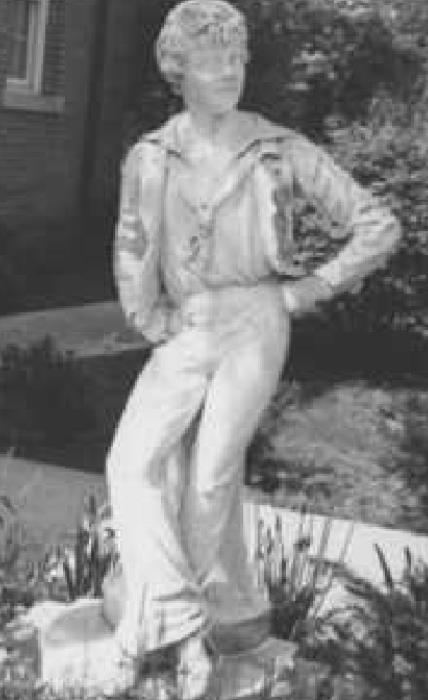


Although not technically part of the Perrysburg park system, a statue of Commodore Perry has stood in stately elegance beside Hood Park for the past 83 years. The original two-ton statue is almost as well traveled along Lake Erie as the Commodore was himself.
On October 14, 1857, Columbus-born sculptor William Walcutt was awarded a contract from the City of Cleveland to design and carve an appropriate monument to honor the conunodore. The eight-foot, two-inch-tall sculpture was cut from Italian Carrara marble in a studio in Cleveland.
On September 10, 1860— the 47th anniversary of the famous battle—the statue was placed in the center of Cleveland’s Public Square with some 30,000 people looking on, including Mr. Perry’s son and several surviving veterans of the fight. A sailor and midshipman were added on either side of the conunodore on December 8, 1869.
After the statue was moved to Wade Park in 1894, and again to Gordon Park in 1913, Cleveland leaders decided to offer the weather-beaten monument to another community and replace theirs with a bronze replica in 1929.
A duplicate bronze replica was given to the corn-modore’s home state of Rhode Island and stands outside the courthouse in Providence.
Sandusky and Put-In-Bay both bid for the original monument, but ultimately Perrysburg was chosen through the efforts of W. J. Veitch and other civicminded citizens. The commodore and his sailors remained in storage at the Eckhardt Monument Company in Toledo until enough money could be raised to have them properly mounted.
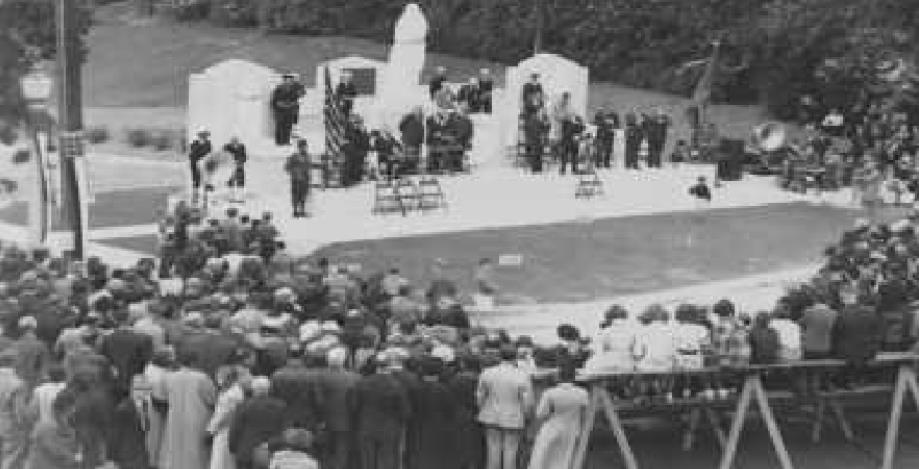
On September 18, 1937, there was a huge celebration and dedication ceremony, with thousands attending. The unveiling was performed by Perrysburg’s only surviving Civil War veteran, S. John Croft, “The Drummer Boy of Shiloh.”
The statue of Perry stood on a pedestal in the center of a large concrete base with the sailor and midshipman on each side. The lower section of the base featured restrooms for public use, though eventually they were closed because of vandalism and disrepair.
To help protect the marble from harsh winter weather, city workers covered the statues with large wooden boxes. However, throughout the years, the concrete on the base began to crumble. With fear of the statues tumbling, they were removed and the base was demolished in 1966.
On December 17, 1966, the commodore alone was rededicated on a new pedestal made of green granite, a rare stone found only in the Andes Mountains of South America, and in Switzerland.
The Country Garden Club led the campaign for the new base, contributing $2,000, with city council approving $6,500 toward the project. The smaller statues were moved to the outdoor courtyard of the municipal building.
Weather continued to take its toll on the statues over the next 30 years, so in 1996 a campaign began to replace the commodore and his shipmates with bronze duplicates. The new monument, as it stands today, was dedicated May 26, 1997.
The marble statue, which holds the distinct honor of being the first public monument in Ohio, was stored in the base of the water tower on Scheider Road for five years awaiting its next move. On February 27, 2002, Commodore Perry returned to Cleveland where he spent several weeks in a warehouse preparing to set sail one last time upon Lake Erie.
The 160-year-old original Walcutt sculpture is now proudly displayed at its permanent location: the visitors center at the national park on South Bass Island in Put-in-Bay. His final dedication took place May 22, 2002. The original smaller figures are safely housed in the atrium of Perrysburg’s municipal building.
Mark Weber is a longtime resident of Perrysburg and a city council member.