
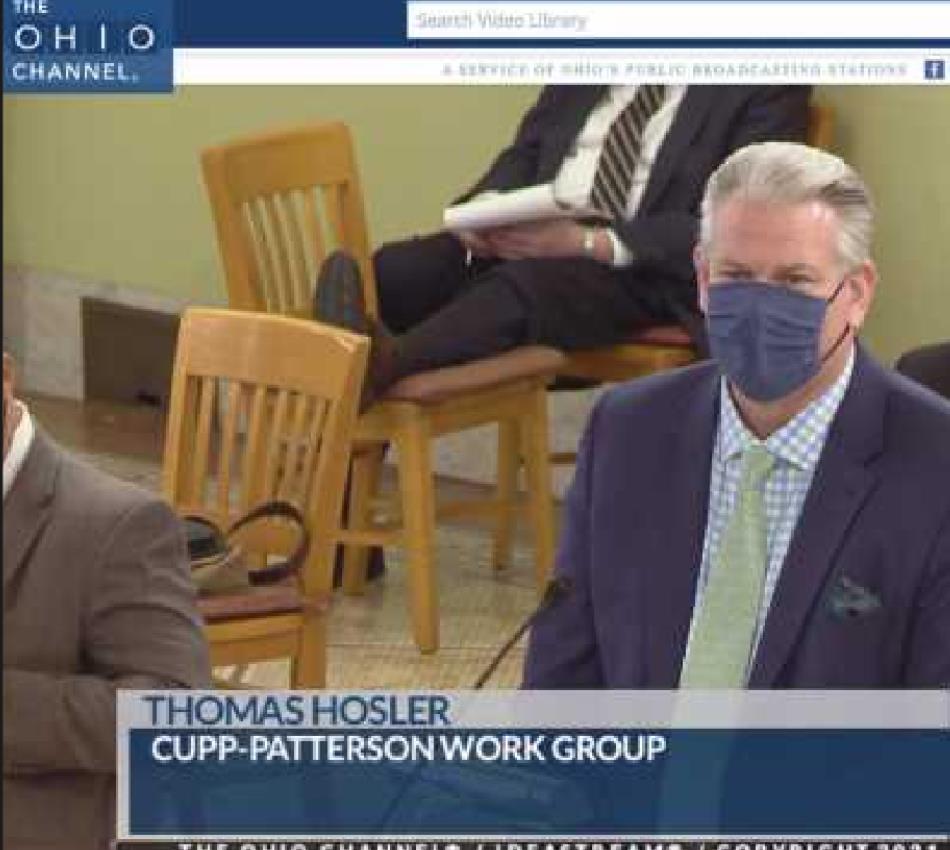
Perrysburg Schools Superintendent Tom Hosler provided testimony on House Bill 110 for the Ohio Senate, Primary and Secondary Education Committee on April 28:
I have been honored to serve as co-chairperson of the base cost subcommittee of the Cupp-Patterson school funding work group along with Akron Public Schools CFO Ryan Pendleton for the past three years. Today, I am offering concluding testimony in support of House Bill 110.
I want to go back to December 3, 2020, when the House passed HB 305 in an overwhelming initial vote of 84-8. On the day of that substantial victory, Representative Callender delivered the following remarks from the floor: “My entire career has been overshadowed by a ruling that our school-funding system was unconstitutional. But in all of that time–27 years–this is the first time there has been a bill on this floor that universally is acknowledged as meeting the constitutional requirements. Twenty-seven years. That’s a long time.”
Reflecting on the weight of that statement–27 years is significant. The optimism is palpable.
More recently, I read Chairman Brenner’s heartfelt comments about students emerging from the pandemic with the passage of Senate Bill 111 where he stated:
“Our students have been through the ringer over the last school year. This funding is vital to helping our schools, teachers, and students resume in-person learning–which we know is imperative psychologically, mentally, and pedagogically–as safely as possible. We all want the children in this state to be able to return to their normal lives, and this is the first step.”
And Mr. Chairman, we couldn’t agree with you more.
These comments reveal an acknowledgment that in helping our schools, teachers, and students in Ohio, it takes an effort to address all aspects of the educational process including supporting pedagogy, safety, and mental health. While referencing funding being vital to the cause to help with that mission during the pandemic, to those of us in the field, your words are just as important to us in our mission after the pandemic. From Representative Callender’s comments in December to this moment, the words you spoke when being named chair of this committee, “I look forward to working with my colleagues, from both sides of the aisle, on improving Ohio’s education policies and putting students first,” have never rung more true.
When we began this work in the fall of 2017, the students in the Class of 2030 were starting kindergarten. The Class of 2030 was a constant reminder for us that our work to find a fair school funding model for Ohio must remain focused on the students and the classroom. We believe that this plan does just that. We owe it to all Ohioans, especially the Class of 2030, to finally get school funding right for future generations, regardless of their zip code. In 2017, a better time financially for the state, an estimated 80 percent of Ohio school districts were not on the state’s school funding formula.
Today, the Class of 2034 is registering for kindergarten across the state of Ohio. Today, 100 percent of Ohio school districts are not on the state’s school funding formula.
During previous testimony, dedicated educators have described a comprehensive, transparent, objectively determined and thoroughly justifiable school funding model that references national norms and research and practices in other states, but also relies heavily upon Ohio expertise and data when answering the question, “What do Ohio’s school-aged youths need in order to acquire a high-quality education?”
The result is House Bill 110 which thoroughly and effectively addresses one basic tenet: Ohio must provide the educational opportunities that every student needs to be successful, and ensure that every district has the resources to satisfy those very diverse student needs.
The three necessary components for meeting those goals include:
1. Determining an individual student’s “base costs.”
2. Determining a fair local share of the shared joint funding responsibility for every district. 3. Determining the cost of additional support services necessary to assist students with additional needs, and ensure the smooth operation of successful school districts.
Summary of the Plan
This plan funds students where they need it most, through a meticulously constructed base cost formula, and provides other funding components to support Ohio’s youth in a variety of important ways. This comprehensive plan starts with the moment students are picked up in the morning until they log off their school computer that night. Everything educationally that occurs between those two events has been considered. This is the benefit of having the perspective of those of us in the field be part of the work group.
My colleagues have spent nearly three-and-a-half years working on each of their respective categorical aid components. They have become experts and their bill components are both essential and comprehensive.
Yesterday, Ryan Pendleton and I described the development of the new per pupil base cost–a process of determining component-by-component the necessary instructional and support personnel, services, and building and district leadership essential in providing every public-school student the basic foundational funding before any additional services required by students with special needs–for a quality educational opportunity.
Jenni Logan, CFO of Lakota Schools in Butler County, shared that for the first time, the state would provide full funding for special education for students with disabilities as well as additional monies for catastrophic special education situations. She also described the prescribed changes from specific dollar amounts for existing special education and English learner categories to weights, so that increases in base cost amounts would be automatically and proportionately applied to these categories.
Marlon Styles Jr., superintendent of Middletown City Schools and Claudia Zaler, CFO of Waverly Schools, discussed the results of three major national studies regarding the needs of economically disadvantaged students that led to the conclusion that Ohio’s current funding level for these students is woefully inadequate. They indicated that the bill provides an immediate prioritized 55 percent increase in the state’s per pupil amount for these students, pending the outcome of a thorough study of the needs of this population and the necessary services to meet those needs. The bill also calls for every 4-year-old child identified as economically disadvantaged to be provided access to at least one year of quality preschool.
Michael Hanlon, superintendent of Chardon Local Schools, led you through perhaps the most complicated and, arguably, most critical aspect of the formula, a balanced method for determining a school district’s local share that is applied uniformly and fairly to every school district in the state, whether wealthy or poor. He explained that, unlike the most recent formula, the new local share calculation consists of 60 percent reliance on property valuation and 40 percent on resident income, and reflects only those conditions of the district itself without any impact from changing conditions elsewhere.
He explained that the concept of district capacity, as determined by both property and income wealth, is multiplied by a percentage–previously often referred to as a “charge off”–in order to determine a district’s local share of the calculated funding amounts. He pointed out that, due to the irregularities and inconsistencies under the previous formula, more than 350 of the state’s 610 school districts were on a guarantee, thereby being paid more state aid than the formula called for, and approximately 140 districts received less than the formula said they were owed. Prior to this current biennium budget, we heard State Superintendent Paolo DeMaria state that no school district in Ohio is on the formula today.
My colleagues further noted that by applying variable percentages to district capacities–based upon a district’s income compared to that of state median income–the distribution formula creates local shares that accurately reflect a district’s ability to pass levies, and to fulfill its obligation in its school funding partnership with the state.
A district’s local share is applied to all of the various funding elements discussed above, except for monies for the economically disadvantaged.
Scot Prebles, superintendent of Forest Hills Local, discussed the bill’s provision that calls for the state to fund transferring students where they are taught; including students who transfer from their resident district through open enrollment or to community schools, as well as when taking advantage of vouchers. This eliminates the need for transfers of money from the resident districts to the location where these students will be educated.
He also explained the new base cost formula for community schools which uses the same components that are used to construct the new traditional school base cost, with some adjustments to reflect the differences in their circumstances.
Carrie Herringshaw, treasurer of Penta Career Center, also described the creation of a new base cost formula for career tech centers that utilizes the same format as that for traditional schools but adjusts for the lower pupil/teacher ratios to accommodate the more “hands-on” instructional environment in those specialized schools.
She described a temporary new tiered funding formula for educational service centers, which provides each one with additional monies, but with declining per pupil amounts as the number of pupils served increases.
Michael Tefts, superintendent of Wooster and Cajon Keeton, CFO at Benton-Carroll-Salem, detailed the per pupil amounts for technology included in the base cost calculations, noting that monies were included for bringing internet to the districts, distributing the internet within the district’s various buildings and classrooms, and providing a Chromebook or equivalent for every student grades 9-12.
Kevin Lilly, CFO of Geneva Area Schools, will describe some of the many improvements in the transportation funding model, including:
•A $45 million annual bus purchase program–the first state bus purchase program in more than a decade
•A temporary weighted increase for nontraditional riders, pending the completion of a thorough study to determine actual additional costs incurred by students being transported to community and nonpublic schools
•A change in the calculation of density supplement funding to base those calculations on ridership instead of enrollment
•A change in the calculation of special education transportation dollars to determine state aid by applying the district’s local share or state minimum local share directly to reported actual expenditures
How to Pay For This
The reality is that Ohio does not have a functioning funding formula for its schools. As a result, in both good and bad financial times, Ohioans struggle with the effects of school funding as inexplicable inequities continue to exist between school districts year after year. This lack of a viable funding model wreaks havoc on our school systems. Residents have grown weary of hearing about the need for levies, and businesses and families cannot comprehend how school funding works.
With each generation of students, we have seen the promise of a school funding fix come and go with no change. From self-proclaimed “education” governors to elected officials who promise to unveil their own school funding formula, we remain stuck. What is the cost, decade after decade, of a broken system?
As you know, this plan would be phased in over six years and would cost an estimated $1.99 billion according to the Legislative Service Commission’s calculation of the difference between fiscal year 2021’s estimated state aid after transfers, but before any reductions due to COVID-19 and a fully funded HB 110. So, the question becomes, can Ohio’s current tax structure accommodate the needs of the new funding formula? Stated another way, is it possible to pay for HB 110’s funding increases without requiring tax increases?
Consider that over an eight-year span from FY 2012 through FY 2019, Ohio raised its education funding a total of $1.8 billion, approximately $295 million per year according to the Legislative Service Commission. Phasing in the cost of HB 110 over six years would require increases averaging $333 million per year.
“And if you’ve come this far, maybe you’re willing to come a little further.” Specifically, here is one suggested road map to get there by repurposing funds found in other areas in the budget:
The current two-year budget also includes $675 million in health and wellness monies proposed by the governor. Most of the authorized expenditures for health and wellness programs are similar to the authorized expense categories for the economically disadvantaged, and many of the health and wellness dollars are being used by districts to supplant monies being spent to fund previously established district programs.
And during the referenced eight-year period, FY 2012 through FY 2019, the state also deposited approximately $2.8 billion into the “rainy day fund,” an average of $350 million per year that was not spent for services or other benefits. Clearly, if the general assembly decides to implement HB 110, Ohio’s current tax structure can pay for it.
We have answered the question, “Where will the dollars come from?” But let’s also talk about where the dollars would be going.
HB 110 provides the elusive answer to the school funding challenge by focusing on the student in the classroom. In fact, 75 percent of the formula provides funds directly and indirectly to the classroom.
Since its original introduction to this current bill, Speaker Cupp and Representative Patterson continually listened to feedback from a wide variety of stakeholders and remained committed to working with practitioners. This current bill has gone the furthest and creates Ohio’s own unique funding formula that is based on a simple premise: what each and every Ohio student needs to be successful.
Frankly, there is no “perfect” bill. This work group has been charged with taking an irrational school funding formula and making it rational. The framework that was created makes this formula scalable now and in the future. What we have today is hopelessly broken. What we are proposing is not perfect, but it is very good. To dismiss this plan would essentially mean endorsing our current broken system, which, in good times and bad times, fails our students and taxpayers year after year. We cannot let “perfect” be the enemy of great. For too long, it is as if we have become paralyzed in a quest to find the perfect formula that does not exist. But what we can do is take a very good formula and do our best to make it even better.
Conclusion
House Bill 110 is nearly three-and-a-half years in the making. Over that time, we have been given the gift of focusing on the student in the classroom and what is best for them. And equally important is the state and local responsibility to provide resources in a transparent and understandable way to support students in Ohio.
From transportation to mental health support and everything in-between, this is a comprehensive, transparent and justifiable school funding model that is fair to every district and leaves nothing to chance. It is the most comprehensive and complete proposal seen in decades.
Change is not easy. But, what we have today, what we must endure every budget cycle, and what residents must face in their local voting booth in addressing school funding, makes all of us uncomfortable. All we have to show from our current formula is continued inequities across the state, and that is inexcusable. As the state recovers from COVID-19 and funds become available, this formula would allow funding to flow where it is needed and will make an immediate impact for students in the classroom where 75% of state funding would be provided for combined direct and indirect classroom funding.
Right now across Ohio, we are registering kindergartners for next school year. The Class of 2034. When we began this process, the students in kindergarten were the class 2030. It’s tragic that we are poised to have another class of students in this precarious position–of beginning their educational careers with a broken, inequitable funding system. We owe it to them to do our best to fix this problem. We need to act now, for their futures and for our collective future in Ohio.