

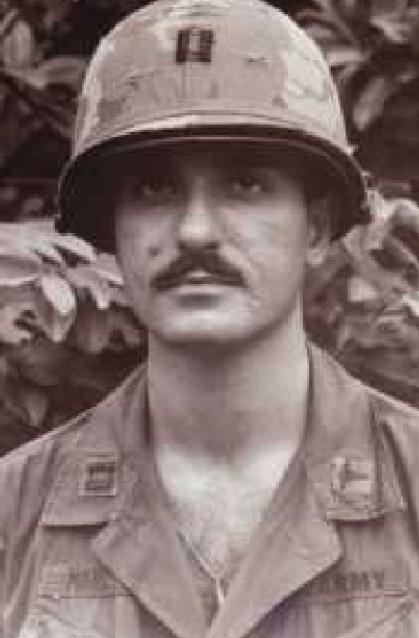
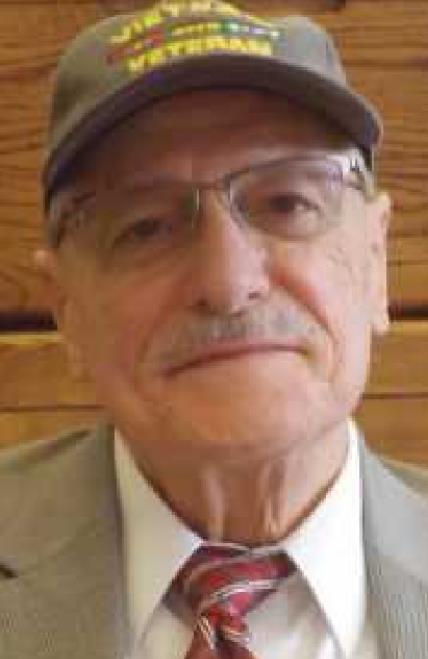
One of the ways Perrysburg recognizes its veterans is through the Way Public Library’s participation in the Library of Congress Veterans Project. The purpose is the preservation of veterans’ service memories.
Recently, the library recorded an interview with Perrysburg resident Dr. Arthur Mancini who served in the United States Army in Vietnam from 1969-70. He served as a company commander for the Charlie Medical Company of the First Division and later as a trauma surgeon at the 27th Surgical Hospital in Chu Lai.
“I was born in Detroit in 1940,” Dr. Mancini said. “My father, a WWI veteran, emigrated from Italy in 1926, coming through Ellis Island along with his two brothers. They worked in the Pennsylvania coal mines, which many immigrants were forced to do when they first came here as they had to have a sponsor to stay. After a few years, they went to Detroit to work at Chrysler.
“The Mancinis did not work well under others. They bought a grocery, starting an Italian food wholesale business, becoming quite successful.
“I went to St. Mathew’s Grade School and Austin Catholic Preparatory School. College was John Carroll, a Jesuit University in Cleveland. I thought I might be a psychologist. There was a great interest in psychology in the 1950s, much talked and written about. I started but changed my mind, switching to pre-med.
“I graduated with honors. I think God had been pushing me along. I got accepted to the University of Michigan, which was my dream. From 1962-66 I was in medical school. After a class in dissection, a light went off: I wanted to be a surgeon.”
Before Dr. Mancini started medical school, a government official talked to his class. “At 18, you had to register for the draft,” he explained. “They offered a proposition, the Berry plan. No one would be drafted out of medical school or first year internship, but they would be required to serve one year afterwards. All of us signed the agreement.”
Upon graduation, Dr. Mancini and his wife, Toledo native, Mary Moran, whom he’d met on a blind date, were married. In 1967, they went to Detroit for his internship. In 1969, he started surgery residency, and that’s when Uncle Sam came knocking.
“They told me I was to be a general surgeon even though I had only one year. But the army tells you what to do and you do it.”
He took six weeks of combat training at Fort Sam Houston. A physician enters the army as a captain. He did not have to live in barracks but stayed with other physicians off base. “We could eat at the mess hall if we wanted, but we preferred not to,” he said, laughing.
In July of 1969, Dr. Mancini left for Vietnam. He would get further orders on arrival, landing in Ton Son Nhat Airport in Saigon.
“I reported to the colonel. He sent me to Lai Khe, 30 miles north of Saigon to become Charlie Company Commander for the Iron Brigade. I’m a surgeon, what is this? They were losing their commander, and I was it. You have to do what the army tells you.” He would also practice medicine there.
“I got my first look at Vietnam on the drive there,” he said. “Agrarian country. No factories, no private cars, only military vehicles. Locals rode a bus or walked. Oxen were used to pull the plows in the rice fields. It was far different from Saigon, which was heavily populated with well-dressed men and women and bustling with motor scooters.
“At Lai Khe was the Third Battalion, First Infantry Division. The complex was a former Michelin rubber plantation, gone to seed. To make it fit for 5,000 men, they flew over and dropped Agent Orange over the entire area to kill the trees and undergrowth.
“The officers were in trailers, the men in tents with wooden floors. Doctors were in the old Michelin laboratory. Circling the entire area were two 8-foot-tall chain link fences with concertina wire on top. If you walked up to the wire and looked out, there wasn’t a single thing growing for at least 150 feet. Agent Orange, once laid out, killed everything, and nothing grew.
“Our quarters were in a concrete building, four officers to a room. Out front were several examining rooms and four isolation beds, a small lab to do blood work. I was one of four physicians, put in rotation for sick call and emergency.
“The North Vietnamese at that time, also known as Viet Cong, did not have tents. They lived underground, entire companies. As our brigade was concerned the air force would bomb likely areas. The infantry would then go in and clean outthose left. If it was someplace with a road, they went in trucks. If not, helicopters.
“Daily, we would see soldiers with a myriad of complaints, such as stomach trouble from eating street food or fungal rashes which spared no one. Malaria was prevalent. Guys were supposed to take pills, but some didn’t. Dehydration was another. You’re out in the jungle for three days with one canteen.
“In addition are the battle-related injuries and battle fatigue, known today as PTSD. Guys would see their buddy shot and have nightmares. We sedated them with Thorazine so they could sleep, and they eventually came out of it. But they didn’t forget what happened. This trauma wasn’t recognized—as it is today—that it could be a permanent situation.
“Lai Khe had a nickname, Rocket City. The Cong would shoot rockets into our compound, primitive weapons shot from a branch stuck in the ground, not accurate. One missed and went into the town and hit a house. We later found out it was deliberate. The mayor of the town had ticked them off in some way.”
In January of 1970, Dr. Mancini was assigned to new duty in Chu Lai. It was the 27th Surgical Hospital, a 125-bed American type hospital. “There were six different surgeons. We had a lot of nurses. Nurses run hospitals, doctors are just there. I was accepted right off.
“The only difference between Lai Khe and Chu Lai, helicopters were the mode of transportation. We were dead center of the Americal Division. I flew on helicopters every so often. They told us to sit on our helmet as the Cong would shoot underneath through the bottom of the helicopter.
“We did all sorts of cases. One was my first introduction to an IED. We are familiar with them today, but Vietnam is where they started. This soldier’s truck hit one. He had injuries to all his extremities resulting in partial amputation. I did not operate on him, but I saw him about 10 days later.
“I asked him how things are going. He said, ‘Look at me, Doc, I can’t even kill myself.’ I thought I’m in for it here so I sat down and talked to him. He was quite depressed, but everything was healing. I told him he was going to a hospital ship in Japan. I said, ‘They will fit you with four prostheses, one for each arm and leg. You will not leave there until you can use all your extremities on your own.’
“He lifted his head a little, but didn’t smile. I think I made him believe there was a chance. But that’s the kind of thing you see in war.
“On the subject of LED’s, the soup can type was the simplest. A hole was dug in a trail where GIs were passing. A hole was put in the top of the can with a nail touching the shot gun shell, brass pointing up. The nail sticks out above the can. Dirt and buffalo dung covered it. The soldier would bump the nail and the shell went off into his leg along with all the filth and dirt.
“I remember one soldier I treated. First I had to debride the wound because the buffalo dung causes infection, which why it is spread over the bomb. When I turned him over, the back part of his knee was gone. This is the first surgery I had done in this hospital.
“I cleaned everything in the back of his leg, spending three hours fixing this guy. Got all the dirt out and packed the wound with Betadine. We saved his leg. He went to Japan for a skin graft. I don’t know how he made out. We never knew what happened to anybody.
“We saw some Godawful stuff. But you know, you become immune. I realize now that this is where I learned how to be a real surgeon. We worked so fast we could take care of people in half the time civilian surgeons could, and we did it without CT scanners and MRI units. Those times are still with me, and that was 50 years ago.”
Dr. Mancini finished service in July of 1970. He joined a urology surgical group at Henry Ford in Detroit.
In 1973 he came to Toledo and worked at Flower Hospital and Toledo Clinic. He moved from Ottawa Hills to Perrysburg in 2004.
“You ask how I feel about serving my country. My father was in WWI; my father-in-law was in WWI. Four of my uncles were in WWII. I had cousins in WWII. Even though it was a great worry for my family, my arrival home made me realize how proud my father was of me for serving my country—and I was proud too.”
Richard Baranowski is a librarian at Way Public Library and a local historian.